
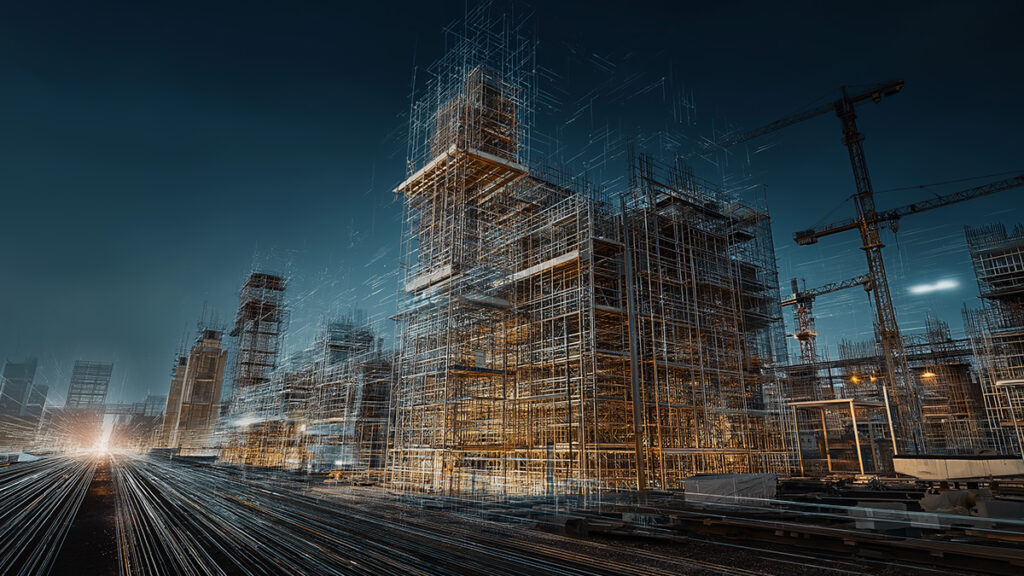
The concrete might be old-school, sun-bleached, and full of rebar, but the intelligence behind it is getting smarter. Artificial Intelligence (AI) is carving out serious space in the construction industry, replacing guesswork with data, brawn with brains, and inefficiency with algorithms.
What was once slow to evolve, the construction industry is fast becoming a playground for digital disruption. It’s a complete shift in project management and how projects are conceived and delivered. Let’s break down AI in construction and how it’s reshaping everything from design to demolition.
From Blueprints to Binary: AI in Design and Planning
Architects used to sketch. Now they prompt. Generative design tools like Autodesk’s Spacemaker and TestFit are automating the grunt work of early-stage planning. These systems process zoning laws, budget caps, site topography, and sustainability goals to iterate hundreds of potential layouts. Many of these layouts would be impossible to sketch manually within a reasonable timeframe.
TestFit’s platform functions like a co-pilot. It optimizes layouts for both profitability and compliance in real-time. Developers input their parameters, and the system responds with a range of smart options. Meanwhile, Bentley’s OpenSite+ takes civil planning a step further, automatically generating full site plans in a fraction of the time. AI not only proposes options, but it also flags potential design violations and suggests corrections before plans reach the permitting stage.
The benefits stack quickly. Fewer errors mean fewer change orders. Streamlined planning reduces costly rework. Teams that used to burn weeks on design cycles now iterate in hours. AI is injecting agility into a phase of construction that was notoriously rigid.
The Invisible Engine: AI in Supply Chain Logistics
Logistics can be a nightmare. AI is the wake-up call. Predictive models now crunch weather forecasts, historical delivery data, and project timelines to determine exactly what materials are needed and when. It’s like having a project manager who never sleeps and never misses a detail.
With platforms like CMiC and Versatile, procurement gets sharper. These systems evaluate vendor performance across timelines, quality, and cost, recommending the best fit for each job. Smart algorithms flag price spikes, geopolitical risk, and even local labor disputes that could affect material availability.
Inventory systems are also getting a neural upgrade. IoT-connected devices monitor material levels and trigger automatic reorders, ensuring job sites never run out of critical supplies like rebar or concrete forms. Route optimization tools adjust delivery schedules in real-time, accounting for traffic congestion or unexpected delays. The result? Less waste, smoother handoffs, and more predictable project pacing.
Labor Shortage, Meet Machine Learning
The labor crunch in construction isn’t news, but AI’s role in fixing it might be. Contractors are using AI to predict workforce needs with surprising accuracy. Platforms like ALICE Technologies can simulate thousands of scheduling scenarios, each based on real-world constraints like skill mix and labor availability.
AI helps project managers allocate the right workers to the right tasks at the right time. It learns from past projects to forecast demand for trades like plumbing or electrical work down to the week. This is helping firms avoid both costly idle time and schedule overruns caused by understaffing.
But AI does more than plan; it trains. Natural language systems are being deployed as real-time assistants, helping junior field workers navigate complex tasks with support drawn from manuals, historical data, and expert knowledge. Meanwhile, companies like Trunk Tools are gamifying job performance, tying bonuses to productivity metrics captured through AI.
In hiring, machine learning is also spotting patterns that predict success or risk. It can highlight which types of experience correlate with longer retention or better safety records. This leads to smarter recruiting and onboarding strategies, which are critical when every skilled worker counts.
Robots on the Jobsite: More Than Sci-Fi
The days of imagining robots on construction sites are over. They’re already here, and they’re not stealing jobs; they’re saving time and lives. Built Robotics is putting autonomous bulldozers and excavators to work, handling heavy-duty trenching and grading without direct human control.
Dusty Robotics’ FieldPrint Platform doesn’t need tape measures. It takes digital models and prints full-scale layouts directly onto concrete, millimeter-perfect and ten times faster than manual crews. That’s more than productivity. It’s precision that prevents costly layout errors down the line.
Canvas’s drywall finishing robot smooths and sands with factory consistency. It doesn’t get tired, and it doesn’t make mistakes. On the move, Boston Dynamics’ Spot patrols sites, performs inspections, and collects progress data. Combined with LiDAR and AI-powered cameras, Spot acts as an extra set of eyes with 360-degree awareness.
These bots don’t operate in isolation. They are collaborators in a hybrid workforce. Their role is to handle repetition, danger, and physical strain, freeing up human workers for decision-making, coordination, and skilled labor. The future of the construction industry isn’t human or robot; it’s both.
Eyes in the Sky and Brains on the Ground: AI in Monitoring and Safety
Safety used to be reactive. AI is making it proactive. With computer vision systems, job sites are constantly monitored for compliance. Is a worker wearing a helmet? Is someone too close to a moving crane? The AI sees it and sends an alert.
Platforms like Newmetrix, now integrated into Oracle’s Construction Intelligence Cloud, are flagging hundreds of safety risks daily using an AI engine affectionately known as “Vinnie.” Trained to analyze field photos, site activity, weather patterns, and more, Vinnie delivers weekly risk reports that highlight which projects are most likely to encounter incidents. Since Oracle acquired Newmetrix’s predictive analytics suite, the platform has expanded its capabilities, now combining safety predictions with schedule risk analysis. This integration provides a more comprehensive view of project risk, marking a significant step forward in proactive safety management on the jobsite.
Predictive maintenance is also reducing equipment-related accidents. AI analyzes sensor data from machines, watching for vibrations, temperature spikes, or hydraulic pressure changes that suggest an impending failure. Instead of waiting for a breakdown, teams fix problems before they escalate.
Even behavior gets a safety upgrade. Wearables and mobile apps track worker fatigue, movement patterns, and environmental exposure. If someone is working too long in high heat or demonstrating signs of exhaustion, the system can intervene. Preventive action replaces incident response.
Quality Control That Doesn’t Sleep
Quality control is no longer confined to checklists and clipboards. With AI, inspections are continuous and comprehensive. 360-degree cameras feed real-time imagery into platforms like Buildots and OpenSpace, where algorithms compare what’s been built to what was designed.
AI catches errors the human eye might miss. A misaligned pipe, a missing duct sleeve, or incorrect door placement, all flagged before drywall goes up. That alone can reduce rework by 30% or more.
Drone surveys and smart sensors take things further. These tools analyze thermal data, structural integrity, and even paint finish consistency. AI models learn from defect data across hundreds of projects, identifying trends that humans wouldn’t recognize. This kind of insight is transforming QA from a box-checking exercise into a continuous feedback loop.
And let’s not forget compliance. AI tools can help ensure every element aligns with code, flagging violations early. It’s the digital equivalent of having an inspector on-site 24/7, minus the overtime.
Productivity Without the Guesswork
Schedules are fragile. AI is the shock absorber. With tools like nPlan and ALICE, project managers are replacing static Gantt charts with dynamic simulations that adjust as reality shifts.
These platforms ingest massive amounts of past project data to identify which tasks are prone to delay. Then they offer mitigation strategies: add a second crew, change the sequence, or order materials earlier. It’s not magic. It’s mathematics made useful.
AI also transforms how progress on construction projects is tracked. Systems like Autodesk Construction Cloud pull in data from inspections, RFIs, weather reports, and subcontractor updates. Project managers can ask a chatbot what’s behind schedule or whether a task is ready to start, and the system answers instantly.
What emerges is a tighter, smarter workflow. Projects hit fewer snags, stay on budget, and finish closer to target. AI doesn’t just keep timelines honest—it makes them achievable.
The Roadblocks to Smarter Building
Let’s be clear: AI isn’t plug-and-play. It needs quality data. And in an industry where paper logs still linger and field notes are scribbled on drywall, data quality is a real problem.
Firms must first clean their digital house. That means digitizing workflows, standardizing naming conventions, and adopting centralized platforms for documentation. The effort pays off: better data leads to better AI insights.
Then there’s the human challenge. Change is hard. Field teams may resist new tools, fearing the complexity or job displacement they may bring. That’s why successful firms start with pilot programs. Introduce AI in low-risk areas, like material tracking or takeoffs, and demonstrate its value.
Cost is another friction point. AI solutions aren’t cheap, and thin margins don’t leave much room for error. But focusing on high-ROI use cases helps. Whether it’s cutting insurance costs through safety improvements or boosting bid accuracy with smarter estimates, measurable wins build momentum.
Integration also matters. AI that doesn’t play nice with existing project management tools becomes shelfware. Vendors are improving interoperability, but construction teams must still plan carefully to avoid tool fatigue.
AI Isn’t Replacing Workers. It’s Empowering Them.
Despite what sci-fi movies suggest, AI isn’t a job thief. It’s a job transformer. It removes tedious work, sharpens decision-making, and enhances safety. That means crews can focus on what humans do best: solving problems, building projects and relationships, and adapting in real time.
At its best, AI isn’t a cold machine dictating instructions. It’s a partner. It watches your back on safety, catches mistakes before they snowball, and helps you work faster without cutting corners. The firms embracing this mindset are already pulling ahead.
The future of the construction industry doesn’t belong to robots or coders alone. It belongs to builders who can harness new tools without losing their edge. In this industry, intelligence is no longer just in the hands that hold the hammer; it’s in the code that guides the swing.